Translate

Showing posts with label Ecuador coast. Show all posts

Thursday, July 10, 2014

Visitors

Last time I posted a picture of the wild pig roaming the neighborhood, this week we have had some visitors of the not so cuddly variety.


We were cleaning up the downstairs patio, sweeping, watering, and moving potted plants around, when we found this little guy. He was the size of a small grasshopper, maybe a cricket, I say was, because yes, Mike had to kill him. Scorpion, or alacran, as Fernando taught me.


This one was IN the house, gecko, lizard thing, probably 4" long. He is the biggest that we've seen at this house. We saw a bigger one at the San Alejo house one day we were there visiting. They eat Mosquitos and other bugs, so they can live. Don't really want them in the house, but hey, they were here first. After his picture was taken he scampered into the ceiling.


Plenty of doves, we have at least 3 nests, they make a mess, and are noisy flapping around all the time, but they probably eat bugs too, so they can stay.


These black birds love the orchard area, one of the AC units drips condensation in the plumeria tree, and it's a favorite showering spot for all.


Found this while I was looking for the black bird, yikes! Not a pretty girl! 

The Common Potoo, Grey Potoo, Lesser Potoo or Poor-me-one (Nyctibius griseus), is a nocturnal bird which breeds in tropical Central and South America
This potoo is a large cypselomorph bird related to the nightjars and frogmouths, but like other potoos it lacks the bristles around the mouth found in the true nightjars. It is 33–38 cm long and pale greyish to brown, finely patterned with black and buff, camouflaged to look like a log; this is a safety measure to help protect it from predators, but its mode of perch is also a camouflage. It has large orange eyes.
The Common Potoo can be located at night by the reflection of light from its eyes as it sits on a post, or by its haunting melancholic song, a BO-OU, BO-ou, bo-ou, bo-ou, bo-ou, bo-ou, bo-ou, bo-ou dropping in both pitch and volume.It has special disruptive coloration so it camouflages into a branch, as shown on the picture.

It's been a rough week, we've had some bad news on residency, obtaining our container AND our rentals in the States. We are keeping our chins up, and trying to reach out to anyone who can help. Still working and writing while lounging in the hammock on the coast of a tropical place, so it could be worse! We will keep y'all posted, the adventure is by no means over! We are being FLEXIBLE. 


Oh yeah, and probably headed to the beach and our favorite $3 lunch later, life is still good in Ecuador. Stay tuned.


Thursday, June 26, 2014

Sunday, June 22, 2014

[2014-06-22] sanALEJO House

Here is the first look at the house we are going to in August. It's in San Alejo between San Clemente and San Jacinto. It's right across the street from the beach! If you click the youTube logo in the bottom right corner you can make this bigger. Make sure you read the post before this to get all the details. Hasta Luego, Mike

Sunday, June 15, 2014

Wildlife on the coast

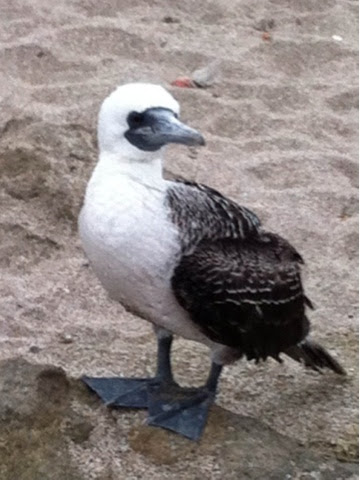
The blue-footed booby (Sula nebouxii) is a marine bird in the family Sulidae, which includes ten species of long-winged seabirds. Blue-footed boobies belong to the genusSula, which comprises six species of boobies. It is easily recognizable by its distinctive bright blue feet, which is a sexually selected trait. Males display their feet in an elaborate mating ritual by lifting their feet up and down while strutting before the female. The female is slightly larger than the male and can measure up to 90 cm (36 in) long with a wingspan of up to 1.5 m (4.9 ft).

The natural breeding habitats of the blue-footed booby are the tropical and subtropical islands of the Pacific Ocean.  It can be found from the Gulf of California down along the western coasts of Central and South America down to Peru. Approximately one half of all breeding pairs nest on the Galápagos Islands. Its diet mainly consists of fish, which it obtains by diving and sometimes swimming underwater in search of its prey. While it sometimes hunts alone, the blue-footed booby mainly hunts in groups.


The name booby comes from the Spanish word bobo ("stupid", "fool", or "clown") because the blue-footed booby is, like other seabirds, clumsy on land. They are also regarded as foolish for their apparent fearlessness of humans.


Its most notable characteristic is its blue-colored feet, which can range in color from a pale turquoise to a deep aquamarine. Males and younger birds have lighter feet while females have darker feet. Its blue feet play a key role in courtship rituals and breeding, with the male visually displaying its feet to attract mates during the mating season. 


The above three pictures are of one we saw on our beach the other evening. Her feet are very dark blue, in the Wikipedia article it said their feet can be darker than normal if they are malnourished, and another blogger in San Clemente posted they were coming inland due to a shortage of their preferred fish. 

Isn't wildlife awesome in Ecuador! Stay tuned, you never know what we'll encounter next, the adventure continues!